BuzzFeds has breaking news, vital journalism, quizzes, videos, celeb news, Tasty food videos, recipes, DIY hacks, and all the trending buzz you’ll want to share with your friends.

Articles by "news"

Image result for PREDICTIONS: The most important things that will happen in tech in 2018
But that's changing. The populist backlash against the tech giants this year bled into the halls of the Senate, culminating in one of the first significant efforts to regulate some of those companies — the introduction of the Honest Ads Act. That proposed law would have required people placing political ads on internet sites such as Facebook and Google to follow the same transparency rules that apply to television, radio, and print.

While that bill stalled, the push for regulation is only going to continue. And the proposed rules could cover a lot more than just political ads.

For example, Democratic Sen. Mark Warner has held meetings with experts looking into whether or not tech companies intentionally make products addictive, according to Axios. The meetings come as a growing number of such experts are warning that the dopamine hit you get whenever your Instagram post gets 100+ likes may not be incidental, but an intended result of the design of such features.

Expect to see additional inquiries along the lines of Warner's. And don't be surprised if you see more bills proposed that might target not only political ads and addiction, but privacy and the industry's arguably anticompetitive practices.

Of course, the chances of any new regulations being put in place by an antiregulatory Trump administration or any new legislation being passed by a Republican-controlled Congress — even in this political climate — is next to zero. But it is significant that more policymakers are keeping a closer eye on the tech industry.

Disney will become Netflix's biggest rival, and a war will begin
Netflix has room to worry in the coming year, because Disney is clearly gunning for it.

The Mouse House's bid to purchase much of 21st Century Fox is clearly aimed at Netflix. But even if the government blocks that deal, Disney is poised to become Netflix's biggest rival.

Next year, the Hollywood giant will launch its first standalone streaming service. That service will be packed full of the conglomerate's impressive collection of movies and television shows, which includes everything from Mickey Mouse to Luke Skywalker. Additionally, Disney-owned ESPN will finally launch its own streaming video service, which should be enticing to those cord cutters who are tired of missing their favorite sports.

But Disney could be in an even better position to challenge Netflix if the Fox deal does go through. In addition to gaining a majority stake in Netflix-rival Hulu, the Mouse House would get access to more live sports, an even broader assortment of valuable intellectual property, including the movie rights to Marvel's X-Men, and a great collection of television series from the FX network.

All of this comes in the wake of Disney announcing that it plans to pull its library from Netflix. That move alone is going to force Netflix to spend billions of dollars to develop new TV shows and movies to replace what it's losing from Disney. Those efforts could succeed — or they could be flops.

Disney, for its part, doesn't have to worry as much about flops. It already has every weapon it needs in its budding war against Netflix.

Tech companies will pour more money into Hollywood — but get little in return
Apple, Amazon, Google, and Facebook are all investing heavily in developing original movies, television shows, and other video content. Each is slated to pour in billions of dollars in the endeavor.

Their ambitions are understandable. For Apple, being able to offer some great TV series in Apple Music would help set the service apart from rivals such as Spotify and Pandora. It would also give Apple a way to squeeze more money out of customers after they buy one of its gadgets.

Meanwhile, Google and Facebook hope to grow their ad businesses by getting a piece of the lucrative television ad market. And Amazon hopes to drive subscriptions to its Prime service, because Prime customers tend to buy more things from it than other consumers.

But motivations and money aside, the tech giants' efforts aren't likely to produce many hits, if this past year is any indication.

Apple's first original shows, "Carpool Karaoke" and "Planet of the Apps," were not only critical duds, there's little evidence they found a significant audience. Google produced shows for YouTube featuring stars including Ellen DeGeneres and Kevin Hart, but viewership has been mediocre. And Facebook's new Watch video service has performed poorly.

While Amazon's had more success both critically and commercially, that success could be undermined by the recent sexual misconduct allegations against its former studio head and against Jeffrey Tambor, the star of one of its most high-profile shows.

Apple appears to have learned from some of its mistakes, hiring a pair of A-list producers to head up its video effort. But it's hard to see how Apple Music in particular can set itself apart from all the other video services with just a handful of shows. It's going to need to build up a much deeper library and is going to need to develop a blockbuster, must-watch show. Good luck.

For its part, Hollywood seems glad to take all the "dumb money" flowing in from the tech companies, as a connected source told New York Times tech columnist Farhad Manjoo earlier this year. To date, the tech giants, aside from Netflix and Amazon, haven't shown that they know much about how to produce great content besides writing a fat check.

But the truth is that the tech companies' seemingly bottomless pits of money can't buy hits. You can hire the best talent in the world, but you also have to know how to get people to watch what they produce. And that's something the tech companies don't seem to have figured out yet. So, get ready for another year of flops funded by dumb tech money.


Image result for Recreational marijuana is officially legal in California
LOS ANGELES (AP) — The arrival of the new year in California brought with it broad legalization of marijuana, a much-anticipated change that comes two decades after the state was the first to allow pot for medical use.

The nation's most populous state joins a growing list of other states, and the nation's capital, where so-called recreational marijuana is permitted even though the federal government continues to classify pot as a controlled substance, like heroin and LSD.

Pot is now legal in California for adults 21 and older, and individuals can grow up to six plants and possess as much as an ounce of the drug.

But finding a retail outlet to buy non-medical pot in California won't be easy, at least initially. Only about 90 businesses received state licenses to open on New Year's Day. They are concentrated in San Diego, Santa Cruz, the San Francisco Bay Area and the Palm Springs area.

Los Angeles and San Francisco are among the many cities where recreational pot will not be available right away because local regulations were not approved in time to start issuing city licenses needed to get state permits. Meanwhile, Fresno, Bakersfield and Riverside are among the communities that have adopted laws forbidding recreational marijuana sales.

For those who worked for this day, the shift offered joyful relief.

"We're thrilled," said Khalil Moutawakkil, founder of KindPeoples, which grows and sells weed in Santa Cruz. "We can talk about the good, the bad and the ugly of the specific regulations, but at the end of the day it's a giant step forward, and we'll have to work out the kinks as we go."

The state banned "loco-weed" in 1913, according to a history by the National Organization for the Reform of Marijuana Laws, the pot advocacy group known as NORML. The first attempt to undo that by voter initiative in 1972 failed, but three years later felony possession of less than an ounce was downgraded to a misdemeanor.

In 1996, over the objections of law enforcement, President Clinton's drug czar and three former presidents, California voters approved marijuana for medicinal purposes. Twenty years later, voters approved legal recreational use and gave the state a year to write regulations for a legal market that would open in 2018.

California joins a growing list of states to legalize recreational weed
Today, 29 states have adopted medical marijuana laws. In 2012, Colorado and Washington became the first states to legalize recreational marijuana. Since then, five more states have passed recreational marijuana laws, including Massachusetts, where retail sales are scheduled to begin in July.

Even with other states as models, the next year is expected to be a bumpy one in California as more shops open and more stringent regulations take effect on the strains known as Sweet Skunk, Trainwreck and Russian Assassin.

The California Police Chiefs Association, which opposed the 2016 ballot measure, remains concerned about stoned drivers, the risk to young people and the cost of policing the new rules in addition to an existing black market.

"There's going to be a public-health cost and a public-safety cost enforcing these new laws and regulations," said Jonathan Feldman, a legislative advocate for the chiefs. "It remains to be seen if this can balance itself out."

At first, pot shops will be able to sell marijuana harvested without full regulatory controls. But eventually, the state will require extensive testing for potency, pesticides and other contaminants. A program to track all pot from seed to sale will be phased in, along with other protections such as childproof containers.

Jamie Garzot, founder of the 530 Cannabis shop in Northern California's Shasta Lake, said she's concerned that when the current crop dries up, there will be a shortage of marijuana that meets state regulations. Her outlet happens to be close to some of California's most productive marijuana-growing areas, but most of the surrounding counties will not allow cultivation that could supply her.

"Playing in the gray market is not an option," Garzot said. "California produces more cannabis than any state in the nation, but going forward, if it's not from a state-licensed source, I can't put it on my shelf. If I choose to do so, I run the risk of losing my license."

In 2016, the state produced an estimated 13.5 million pounds of pot, and 80 percent was illegally shipped out of state, according to a report prepared for the state by ERA Economics, an environmental and agricultural consulting firm. Of the remaining 20 percent, only a quarter was sold legally for medicinal purposes.

That robust black market is expected to continue to thrive, particularly as taxes and fees raise the cost of retail pot by as much as 70 percent.

Image result for Trump made a revealing, off-the-cuff comment that could explain why he hasn't fired Mueller
President Donald Trump told The New York Times in an interview published Thursday that the investigation into potential collusion between his campaign team and Moscow had strengthened his base and prompted some "great congressmen" to begin "pointing out what a witch hunt the whole thing is."

Trump told The Times that he did not intend to fire Robert Mueller, the special counsel leading the investigation.

But while Trump said he expected Mueller would treat him "fairly," his remark about how the investigation had galvanized his supporters is perhaps a better indicator of why Trump may have taken firing Mueller off the table, for now, as it suggests he is aware of, and confident in, his allies' ongoing campaign to undermine and discredit the special counsel.

"Virtually every Democrat has said there is no collusion," Trump told the newspaper.

He continued:

"There is no collusion. And even these committees that have been set up. If you look at what's going on — and in fact, what it's done is, it's really angered the base and made the base stronger. My base is stronger than it's ever been. Great congressmen, in particular, some of the congressmen have been unbelievable in pointing out what a witch hunt the whole thing is. So, I think it's been proven that there is no collusion."

The most recent attacks on the FBI by Trump and his supporters began after news surfaced that the Department of Justice's Office of the Inspector General discovered text messages exchanged by two FBI employees, Peter Strzok and Lisa Page, during the campaign that expressed disdain for Trump and other political leaders.

Strzok, a veteran counterintelligence agent, was among those overseeing the investigation into former Secretary of State Hillary Clinton's private email server last year. He and Page and were also members of Mueller's team, but Strzok was removed in late July after the texts were discovered, and Page left for unrelated reasons.

A senior Justice Department official and his wife, meanwhile, have come under fire for their reported ties to Fusion GPS — the opposition-research firm that funded the collection of memos known as "the dossier" outlining alleged Trump-Russia collusion. The official, Bruce Ohr, was recently reassigned.

There is no evidence so far that these revelations have affected the public's perception of Mueller or the Russia investigation. A CNN poll released earlier this week found that more Americans approved of how Mueller was handling the investigation than disapproved.

But the incidents have fueled GOP lawmakers' calls either for FBI Director Chris Wray to clean house or for Mueller to resign.

Republican Rep. Francis Rooney on Tuesday said he wanted to see the upper ranks of the FBI purged of politically motivated agents whom he believes were working for "the deep state."

Another Florida congressman, Rep. Matt Gaetz, has accused Mueller and his team of staging a "coup d'etat" against Trump. Rep. Jim Jordan of Ohio has called the FBI "corrupt" and claimed recently that the bureau was "putting together a plan" last year "to keep Donald Trump from becoming the next president of the United States."

Jordan said earlier this month that he'd been in touch with the White House about Mueller. Gaetz, the first lawmaker to openly demand Mueller's firing, discussed the special counsel's investigation with Trump aboard Air Force One earlier this month ahead of a rally in Florida.

Rep. Ron DeSantis, a House Judiciary Committee member who put forward a provision in August that would have severely limited the scope and funding of Mueller's investigation, was also on the flight with Gaetz and Trump.

GOP Rep. Andy Biggs recently slammed what he called Mueller's "unlimited reach" and "unvetted hires," accusing the special counsel of making "blatantly partisan hires that place the direction of his probe under a cloud of suspicion" and calling on him to "step aside."

Republican Sen. Rand Paul tweeted last week that it was "time to investigate high ranking Obama government officials who might have colluded to prevent the election of @realDonaldTrump! This could be WORSE than Watergate!"

Image result for South Korea And Japan Working To Overcome Comfort Women Issues
Japan and South Korea recently agreed to build future-oriented relations and work together to protect both nations from North Korean threats. This comes on the heels of the 2015 resolution related to the Japanese use of South Korean comfort women between 1910 and 1945 when the Korean Peninsula was under Japanese colonial rule. Japan has sought to make amends for having Korean comfort women in brothels meet the needs of Japanese soldiers. The two countries are working together to heal the rifts caused by that chapter in their histories. In South Korea the comfort women testimonies brings back painful memories.

Moon Jae-In, South Korean new president, met with Shinzo Abe, the Japanese prime minister, in Hamburg, Germany recently during the Group of 20 summit to discuss ways the two countries can work together to protect their citizens from North Korean aggression. While President Moon Jae-In knows most South Koreans aren’t happy with the 2015 comfort women settlement agreement signed by his predecessor, both South Korea and Japan are looking for the best way to move forward together and address the dangerous threat North Korea poses.

The two governments see a dual-track approach as the best way to heal the wounds exposed by the comfort women stories while dealing with the North Korea menace.

Newly elected President Moon Jae-In, a former human rights lawyer, had pledged during his presidential campaign that he would renegotiate the Korean comfort women agreement.

A recent polls showed that’s what 70% of South Koreans want. However, since taking office President Moon has said he wouldn’t let this one issue derail bilateral relations between his country and Japan.

South Korea, Japan and the U.S. are closely coordinating their activities to counter the nuclear and missile threat posed by North Korea. South Korea also faces economic retaliation from China over the Terminal High Altitude Area Defense system the U.S. has deployed there. China’s seeming unwillingness to hit North Korea with tough sanctions has prevented South Koreans from seeing the Chinese as being a reliable strategic partner.

In a meeting in Washington D.C. in late June, it was acknowledged the comfort women agreement’s implementation is vital for South Korea and Japan to work together. Experts say President Moon is working to find a solution that satisfies both his nation’s emotional and security needs by using the dual-track approach to resolving the issues related to the South Korean comfort women and protecting his people from North Korean aggression.

North Korea recently tested an ICBM experts say could reach Alaska. It’s a major step forward for their missile program compared to 10 years ago. Earlier this year, experts estimated North Korea had enough fissile material to produce between 10 and 20 nuclear warheads and the technology to build a ‘miniaturized’ warhead which could strike South Korea, Japan and U.S. military bases in Guam if mounted on short- and medium-range missiles. This makes resolving the comfort women issue and dealing with the North Korean threat more urgent.

In an attempt to calm South Korean public sentiment about the comfort women agreement, the foreign ministry of South Korea is creating a task force to look at the process that led to the agreement in which Japan gave ¥1 billion to the surviving women and a sincere apology for their suffering to “finally and irreversibly” settle the issue and in exchange North Korea agreed to remove a statue facing the Japanese embassy in Seoul, South Korea symbolizing the comfort women.

Despite their differences, on June 3, South Korea and Japan agreed to keep the General Security of Military Information Agreement they signed last November.

Image result for The future is here? – 2018
Modular atelier has become a commonly spoken term in the world’s globalized cities referring to the specs of the aesthetics of a module, in the 21st century.

The more we move into the future, the better we become at managing our day to day activities, moving towards an optimal lifestyle which is conscious of our needs and wants. It has now become a common creative practice to invest in oneself, or someone else, to promote the adoption of modular strategies which in turn increases efficiency and is expected to minimise time of stress of confusion.

As a simple demonstrative example, adopting a modular T-shirt which is plain in colour with up to say a trivial logo, facilitates the use of the T-shirt on a broad range of activities, when compared to adopting a T-shirt with a Superman logo, which will decrease the general suitability of the T-shirt for use with certain activities; generic is broader in every aspect. Certainly, with this example of a T-shirt, it is arguable that modularity may not be the most contemporary for use in every design aspect when demonstrated within clothing and textiles, it does sound true. Textiles are flexible materials by nature and therefore they are bound to be flexibly arranged to produce textile objects, and therefore we could argue that modularity may not be the most desired in every design industry, however it must exist at some scale in every design industry and many would agree that modularity is the right and the conscious way when working with productions of solid materials such as wood and steel as it is more efficient when we adopt a modular approach with solids, from every aspect,. Obviously, the advantages embedded within such a shift would include, but are not limited to, the extension of the lifetime of the production, improving the resilience of the production, reducing the time to maintain the production, and reducing the amount of energy required to produce the production, to name but a few.

The future lies in a green world, a man-made world integrated consciously and in harmony with nature and the environment. A new emerging generation of young entrepreneurs are coming up with different creative techniques which promote for modularity, for example, the invention of the spinner toy was a giant wave that introduced a new genre of products which are meant to keep creative practitioners stimulated.

Students from Leeds University in the UK are fascinated by concepts of the modular atelier and created a creative booth for their desk tools, they claim to use these tools to increase the efficiency of their minds whilst performing hectic desk work for long hours. An all-known example of such a tool is the spinner toy which came to rise in amidst the past year.

A charitable organisation named Atelier Modular played a role, in March 2017, bringing the spinner toy to all 7 continents of the world, however people are only attained to the spinner toy, unaware of its’ concept which underlines a new generation of products which we may consume finitely in fact, this type of products have only come to rise in recent years, and are meant to be an eccentric material which promotes for creativity, you may well find an awe-inspiration from every product built on the modular atelier approach.

The future is already here, it is only not everywhere yet and it holds existing and coming technological revolutions limited only by our imagination, which will ultimately transform our lifestyles. It is well absorbed that the future only lies in our commitment to change - The internet is here and it’s all on the internet.

Image result for Atlanta Web Design Agencies Delivering Value to Local Businesses
Web design has moved on pretty-darn quickly and back here in Atlanta, local agencies have made their mark designing excellent sites for businesses. With local companies having unique needs, be it in marketing or specialized design techniques, local firms are helping businesses reach their potential. Noted industry observers like Tech.co are also recognizing the value proposition that local web design agencies are bringing in. In a news article, they note, “there are many wonderful companies out there that are capable of helping small businesses reach their full potential.” Be they chatbots, prediction technologies, and smart devices, Atlanta web design agencies are helping local businesses make the transition to conversational user interfaces.

Visuals are good, but text engages

Today, web design is more about a conversation with the end-user and combining it with functional visuals. Check out Alexa, Telegram, or Messenger, and the focus has shifted to words. The trend is growing, and that is why the coming trends in website design would be focused on wordsmiths that can create scripts that the user would love conversing with. Web design firms are taking these discussions to local businesses, aiding them in seeing the value of interactivity. Being close to their customer, these agencies can better understand the local needs and support enterprises to with designs that would help them with better customer acquisition capabilities.

Designs with a purpose

Talking about conversations, it is customer insights that are most important when designing for the web or devices. The extra time to reflect on what the needs of the user are and what the company intends to achieve through the design is of utmost importance. Local web design agencies in Atlanta are making a big difference by offering clients effective strategies and consulting practices that lead to the efficient execution of their needs.

This perspective on web design implies that for any design to be set right, the purpose needs to be established first. As with any system design, transactional aspects of an interaction and user flows are taken into consideration. Rich experiences that incorporate the aspirations of local customers, their traditions and needs are becoming the norm. Human factors, especially psychology and their behavior online are contributing to how online presence is being designed. Users need to be able to achieve their objective, and local web design agencies are helping businesses build that convenience for their end-users.

Responsive design

Responsive designs are the buzzword. This involves designing customized user experiences and are not only about appearances. Traditionally, when one talks of responsive design, the typical responses that you will get will be how your screen elements should render well on different devices. While that was the initial approach to building responsive websites or using CSS to provide pages correctly on multiple devices or screen sizes, it is much more than that.

The process starts with putting together a strategy to achieve the goals and a structure that would help the target users navigate the website without confusion. A clear set of calls to action is required that would be important to create the customer conversions. As always, the visual design needs to be clutter-free, with easy information access and designed to enable optimal loading of the websites. In addition, all websites need to be consistent in design and branding. It is imperative to establish style guides and standards that could be followed across all areas of a website and thus help deliver a professional message to the user.

Local presence in Atlanta

In this day of a globalized world, this might seem a little out-of-place. After all, accessing a global pool of professionals gives you a greater choice. With the Internet and the setting up of appropriate governance and communication mechanisms, projects executed by a designer who is miles away from you can also succeed.

Working with a local designer, however, has multiple advantages. A neighbor tends to be more loyal to local businesses, and no one would want a neighbor who is unhappy. In addition, they would know your competition better as they are much more aware of the local business landscape than someone sitting miles away. A designer or a design company that is located far off will have no connection or feel of local needs, and you end up just being another customer. Your design needs will tend to be put into a theoretical framework. Also, it is easier to just pick up a phone or just visit your local designer when you need urgent help. It is also easier for them to send over support personnel to investigate an issue if you are nearby.

The barebones

Local designers are unanimous that web design has come a great way and CSS has made life much easier for the designer. A website can be created by literally anyone with products that offer almost everything as a drag and drop function. However, they note that the basics are still as important as they were always. Visual weight, navigation design, and directing the user around the screen are basics that should never be overlooked. Typography and layout, the positioning of screen elements and site usability determine user engagement too. While the basic structure can be designed quickly, you also need to be sure that when you launch your website, it has the appropriate quality regarding responsiveness and is also appropriately optimized for the search engines to crawl and index them.

Again, usability is subjective, but if you get down to the nitty-gritty, it is all about making a sensible website. For example, it should be easy to figure out the theme of a website by visiting the homepage itself. Simplicity has always been voted in by users, and multiple studies have shown that web design elements can still distract a user. An irritating pop-up, interruptions while reading, dull colors, and small font sizes can put off a reader, though the content might still be engaging.

Clutch, a B2B research, ratings, and reviews firm while announcing the best web design agencies for 2017 said, “the importance and value of strong UX have become more apparent in recent years, and these Atlanta agencies have proven their ability to deliver on this crucial aspect of design.”

Image result for UFC 219: Cris Cyborg beats Holly Holm to retain featherweight title
Cristiane ‘Cyborg’ Justino - known to the MMA world simply as Cris Cyborg - cemented her position as the world’s premier female featherweight fighter with a hard-earned unanimous decision victory over former UFC women’s bantamweight champion Holly Holm after five high-octane rounds at UFC 219 in Las Vegas.

Holm started impressively, using her footwork well as she effectively counter-struck the champion in the early stages of the contest, working well off the back foot as two of the three judges scored the first two rounds to the challenger.

But as the fight wore on, Cyborg’s power began to take over as she started to read Holm’s attacks and walk down the challenger, punishing her with heavy punches and kicks.

Both women showcased their durability and conditioning as they traded shots for the full 25-minute duration as their five-round title fight went all the way to the scorecards.

And, when the judges rendered their verdict, their scores told the story of a closely-contested matchup, with the champion taking the unanimous decision with scores of 49-46, 48-47, 48-47 to take her career record to 19-1 (1 no contest).

“I want to say thank you to Holly Holm,” said Cyborg after the bout.

“She’s an amazing fighter and she did really well here.”

The world champion said she’d next like to face the fighter who succeeded her as the Invicta featherweight champion when she left to join the UFC.

“I would like to fight somebody at 145lb. Maybe fight Megan Anderson in Australia,” she suggested. “I have a lot of fans down there.”

Nurmagomedov calls for Ferguson after battering Barboza
In the night’s co-main event, Russian one-man wrecking crew Khabib Nurmagomedov extended his perfect professional career to 25-0 with a three-round battering of No.4-ranked lightweight contender Edson Barboza.

Barboza has a well-earned reputation as one of the division’s best strikers but Nurmagomedov closed the distance with ease, taking the Brazilian to the mat and pummelling him with strikes in the first round.

Nurmagomedov dished out more of the same in the second frame, as he showcased his ground fighting dominance with another 10-8 round.

And while Barboza was able to land a spectacular spinning kick to the Russian’s head in the third and final round, Nurmagomedov just walked straight through it and continued his relentless assault on his way to a landslide decision win.

The judges scored the fight 30-25, 30-25, 30-24 to hand the Russian the 25th win of his career and his eighth straight win in the UFC as he told commentator Joe Rogan he’s ready to face either of the UFC’s lightweight belt-holders: "If you give me one hour rest, I can fight Tony or Conor, no problem."

But while many fans are clamouring to see Nurmagomedov face McGregor next, ‘The Eagle’ said if he had the opportunity to choose, he’d pick interim champ Ferguson, saying a bout with undisputed lightweight champ Conor McGregor is unlikely to happen until McGregor “spends all his money”.

Hooker catches Diakiese
It was a disappointing night for British lightweight prospect Marc Diakiese, who fell to his second straight defeat in the octagon with a third-round submission loss to New Zealand's Dan Hooker.

The pair contested a cagey first two rounds, with both men showing each other a lot of respect as they carefully looked to engineer openings. But the third round saw the contest open up, as Diakiese pushed forward, landing some solid punches on his opponent.

But, after a combination had forced Hooker back against the cage fence, the Brit shot in for a takedown attempt and was promptly locked up in a guillotine choke, forcing Diakiese to tap out 42 seconds into the final round.

Decisions, decisions
Former UFC women’s strawweight champion Carla Esparza produced a gritty performance to come from behind and defeat previously unbeaten prospect Cynthia Calvillo by unanimous decision. Calvillo started the better of the two, dominating the opening round, but the former world champ came back strongly in the second round to level things up, then edged the final frame to earn the nod from the judges.

In the opening fight of the night, Neil Magny delivered an excellent performance to ensure that Carlos Condit’s long-awaited return after an 14-month absence ended in defeat. Magny dictated terms for long periods of the contest, scoring a host of takedowns to earn a unanimous decision victory, the 20th of his professional career.

On a night where finishes were at a premium, the fight card delivered eight decisions from 10 contests.

Kicking off 2018
UFC 219 closed out the UFC in 2017, but the action will come thick and fast in the New Year, starting in St Louis, Missouri, as featherweight knockout artists Jeremy Stephens and Doo Ho Choi kick things off on 14 January.

Then all eyes will turn to UFC 220 in Boston, Massachusetts on 20 January as the undisputed UFC heavyweight champion of the world Stipe Miocic will look to become the first fighter to defend the title three times when he faces Cameroonian Francis Ngannou, who knocked out Alistair Overeem in devastating fashion at UFC 218 to book himself into a title fight.

Image result for Europe: What surprises are in store for 2018?
Talk about a poisoned chalice …

"You're the Europe editor," say the BBC powers that be. "Tell us what to look out for in 2018."

Yet if we've learned anything at all from the last couple of years in European politics, it's that hedge betting is a far more comfortable path to take than prediction-making.

A year ago who could have foreseen the Macron phenomenon, taking over the French presidency and dominating the country's parliament?

Who, last December, predicted with any certainty the current painful contortions in German politics or the timings of the Catalan independence explosion?

But Brexit, we knew, would dominate the EU agenda to a large extent, as it will again in 2018.

Brexit: All you need to know
How we laughed - in hollow tones - when European Commission President Jean-Claude Juncker insisted a while back that only 15 minutes per week would be spent talking Brexit in EU circles.

The future of Europe, he insisted, was far more important.

Euroscepticism goes mainstream
In 2017, the EU's future certainly seemed brighter. United over Brexit, the once squabbling member states fell, obediently, in line behind their chief negotiator, Michel Barnier.

The eurozone was on the up, illegal migration figures down. Right-wing populist, anti-establishment, Eurosceptic politicians failed to reach pole position in election after election; such as in the Netherlands, France, Austria and Germany.

But the EU apple was actually never as shiny as all that in 2017.

They may not have won outright, but Eurosceptic populists performed phenomenally well in elections across Europe - most recently in the Czech Republic, which hosted a meeting of European far-right parties in December.

The populist discourse has also bled into mainstream politics as traditional parties scrabble to get ahead in the polls. Just tune in to the Dutch Prime Minister Mark Rutte to get a taster. Or take a look at the new government in Vienna.

A good year for Europe’s far-right, nationalist parties
The Netherlands' populist moment?
Austria protest as far right tastes power
Anti-immigration, Eurosceptic and anti-political Islam messages no longer raise eyebrows in Europe. In fact, these themes look like vote-winners in Italy, heading for elections in spring 2018.

The emperor and the queen
So, to steady the EU course and strengthen resolve, Brussels nursed the hope of a new, roaring Franco-German motor at the European helm after Emmanuel Macron became France's president in April.

This is something I'll be watching closely in 2018.

M&M - aka Merkel and Macron - certainly want to work together.

He needs her to boost his gravitas and to get any of his ambitious eurozone reforms passed.

And she needs him to re-energise her sagging image. Most Germans describe France rather than the US as their closest ally these days. They are charmed by Monsieur Macron (though hesitant about his plans for the euro).

In 2018, I'm interested to see if Mr Macron - dubbed "the emperor" by some - lives up to the hype at home and abroad.

Or will this be a case - rather like Barack Obama who famously received a Nobel Peace Prize before he really achieved anything - of peaking too early?

Mr Macron's EU BFF Angela Merkel is certainly in no fit state to purr as part of anyone's motor.

The slipping crown of Angela Merkel
German election: Why this is a turning point
Formally known as the Queen of Europe, she'll spend the first months of 2018 focusing inwards while she tries to cobble together a new government.

This will inevitably impact the wider EU.

Weaker Germany
As leader of the bloc's biggest, richest nation, Chancellor Merkel pushed for EU vigilance vis-à-vis Russia, prudence when it comes to Donald Trump and involvement in trying to contain Iran.

A fervent believer that EU unity is in Germany's best interest, she liked to keep her beady eye on the bigger picture and her finger on the EU control button.

Her waning influence plus the huge gap the UK will leave behind when it quits the EU has other member states now jockeying for position.

2018 will give us front seats in Europe's bear pit.

Sweden, Denmark and the Netherlands - as well as the countries of central and eastern Europe - want to avoid what they view as protectionist, federalist France gaining the upper hand in EU debates.

They're also keen to have less, not more, Brussels in their lives. And they're not unhappy to see a weaker Germany.

Brexit gets real
So much for the EU unity touted by Brussels; much boasted about in Brexit talks.

There was a lot of it about in 2017. But then, EU countries had a common goal: money - getting the UK to agree to pay as much as possible in terms of financial liabilities before it leaves.

But in 2018 we move to phase two of Brexit negotiations: talk of the future.

And here the 27 European nations differ in what they're prepared to offer the UK - a bespoke deal, or not, and in terms of EU rule-bending.

A couple of New Year Brexit spoilers for you ...

If you thought the Ireland border debate was resolved in phase one of talks, just in time for Christmas...

And if you believe a new EU-UK trade deal will be signed by autumn next year (promised by some British cabinet ministers but impossible under EU law)...

Then 2018 is going to be quite a revelation.

Image result for New Year's resolutions: How do you make one you will keep?
Lose weight, exercise more, quit smoking, learn a language - we can all reel off a list of typical resolutions made and broken.

But BBC Reality Check wanted to know if there are certain resolutions you're more likely to keep?

Well, we can't tell you what resolutions you should make, but we can draw on research to find some clues as to how you should carry them out.

There is evidence that humans are driven by "loss aversion" - that is, we are more motivated to recover loss than we are to win gains.

Framing a resolution as recovering something lost - whether that's an old hobby or a former level of fitness - may be more effective than looking to gain an ability or appearance, for example.

This also feeds into another key piece of advice when it comes to successful resolutions - they must be realistic.

Involve other people
Dr John Michael, a philosopher at Warwick University, studies the social factors involved in making and keeping commitments.

He says that we are more likely to keep resolutions if we can see them as being somehow important to other people - that "other people's wellbeing is at stake" if we fail.

That might mean committing to attend a class with a friend. The effect could be even stronger if you have to pay in advance - once we feel someone has invested time and money in something, we are more likely to see through our commitments.

Dr Michael is currently testing the theory that we are more motivated to prevent loss to other people than to ourselves.

Early evidence from this work suggests that people may be more motivated to continue a boring or difficult task when somebody else has invested effort in it.

Specific cues
Reputation is also a powerful motivator. Making your resolutions public can help you to keep them since the fear that people will think worse of you if you don't see them through will add to your resolve.

"We don't want to get a reputation as unreliable, so publicly announcing our plans can be motivating. Betting can be still more motivating," says Prof Neil Levy at the University of Oxford.

Making detailed resolutions is important, he adds.

Saying, "I'll go to the gym on Tuesday afternoons and Saturday mornings" is more likely to be successful than simply saying "I'll go to the gym more", according to Prof Levy.

He also recommends tying your intentions to specific cues, a practice he calls "implementation intentions".

If you want to learn a language, you might first resolve to listen to a language-learning podcast on your commute each morning.

Then, to improve your chances of success further, you could make sure you stick a note to the steering wheel of your car each night to remind you to play it on your journey in the morning, for example.

You're not just making a intention but also setting out steps to implement it.

Making exceptions
He also warns of the potential for "decisions to become precedents".

"Implicitly we recognise that there are exceptions (I won't go to the gym if the house is on fire). But we can exploit this to our detriment by expanding the exceptional circumstances.

"My birthday may be a legitimate exception which comes once a year. But if I start recognising as exceptional things that occur more often - it's the last week of the month, better to start on the first; or it's too cold to get out of bed so early - then everything tends to become an exception," Prof Levy says.

Make them part of your longer-term plans
For Dr Anne Swinbourne, a behavioural psychologist at James Cook University, Australia, the best resolutions are the ones that achieve a chunk of a longer-term plan you have for yourself, rather than those that are vague and aspirational.

If you've never shown an interest in sport, resolving to become a brilliant athlete is unlikely to stick - resolving to save money because you've always dreamed of travelling the world before you turn 50 might be more successful.

And keeping them is all about planning, she says.

Work out what your triggers are, both to negative behaviour you want to discourage and positive behaviour you want to encourage - if you want to drink less, plan to meet friends for coffee not in a pub.

"People who rely on willpower mostly fail," according to Dr Swinbourne.

"To keep a resolution, you have to be boringly meticulous - you have to plan."

Image result for How To Get Into A Positive Mindset For The New Year
With every year that comes to an end almost all of us, all around the world will start reflecting on the year that we have had, we want to see how far we have come during the past year and what we have been able to achieve. This is also the time that most of us start setting our resolutions for the upcoming year. The end of the year is very important because it gives you a clear view of the time that you have spent building your life or maybe you just wasted the whole twelve months and haven’t quite achieved anything.

Most people would like to think that they will achieve success and be keeping their New Year resolutions and that this success will bring happiness, that couldn’t be further from the truth. Happiness is what brings success, this fact is well documented by Shawn Achor in the book Happiness Advantage. A positive mindset allows the brain to see more possibilities than a negative mindset, a negative mindset makes the brain feel threatened hence closing it to new opportunities.

Most people do not understand it but, when the brain is in a positive state it tends to be three times more creative than when it is in a negative state. If the brain is more positive towards the end of the year it helps the person to be creative with goals that will be set for the New Year and also as the person reflects on their past. Most people will want to get into a positive state of mind before the New Year in this post we will tell you some of the ways that you can do that.

Never Start At Zero

The worst thing a person can choose to do is start off listing down their new year resolutions with nothing, what does that mean? Most people would like to think that they have nothing to start with but, they can start by listing some of the achievements that they have made during the previous year. This will help the person see that they are better off than they were at the same time last year and will give them a reason to carry on further.

When you are closer to the finish line your brain will want to pick up the pace, it will be less enthusiastic if it senses the process is just beginning. As human beings, we tend to have more energy when we perceive that we are getting closer to achieving our goals.

This technique can also be used daily to achieve gradual success throughout the year. An individual should try and focus on what they have achieved rather than looking at what they haven’t. Before the day starts list down the things that you have already accomplished, this is a much more effective strategy than listing the things you are yet to accomplish.

Start Your Day With A Positive Email

Most people would like to start their day by looking through the urgent mails in their inbox. Most often than most these emails aren’t positive mails, most of them usually end up just spoiling the day for most people. To start the day in a positive mind state a person needs to make sure that the first mails they read are positive mails.

The reading positive mail alone will not affect the mindset of a person, it is also by sending some to others as well. Positive communications will help the brain start the day without feeling threatened and it will make it easy for the person to see out the day in a positive manner. Make the day start with positive social connections, the greatest predictor of happiness. According to the author of happiness advantage Shawn Achor, happiness begets success.

Use Positive Language In Goal Setting

You cannot start the year trying to break your negative habits if you don't have positive ones to replace them with if you are not positive you will soon fall back into your bad habits within no time. Try to identify the bad habits that you want to change, if eating junk food is one and focus on avoiding junk food by carrying healthy foods with you every single day. Try to frame everything in a positive light.

The brain will not focus on the negative habits and how you can stop when you have taken the step of changing the vibe into a positive one, the brain will use its energy on the positive idea that you have adopted. The brain only needs the person to start off the idea and dump the bad habits immediately and then it can take over and continue with the good work, that can never happen if the person is waiting for a good way to start avoiding their bad habits, they must start the positive ones immediately and replace the bad ones.

Focus On The Positive Habits

Positive habits should be incorporated into your daily routine so your brain can get used to them. First of all, be grateful for all that you have on a daily basis. Meditating and paying close attention to the breathing will also help as will journaling your positive experiences, always show appreciation to everyone around you at all times.

Most people think that they are way too busy to show appreciation to the cab driver who got them home safely or that waiter who spent countless hours on their feet but still served them with a smile on their face. It is always good to show appreciation to all the people around, you may end up changing the world with that one single act.

Conclusion

There are many reasons that we can look to be positive in the upcoming year, for most people it is all about self-improvement. Being positive will increase your productivity levels and help you to live without stress. See this post about how to program your mind if you want to make real change in the coming year.

Image result for Why Self Care is a Necessity for Human Functioning
As a woman, mother, and psychotherapist- I tend to run on the care-taking side. I grew up in an alcoholic household as the oldest of five desperately wanting to make sure everyone else was taken care of. For a long time I ignored what I needed to charge my own batteries and often felt myself running on empty. Even though my graduate training expressed the importance of self care in conjunction with my role as a mental health professional, it wasn’t until I became a person in recovery, that I realized how vital self care is. Today, my self care is a non-negotiable.

Self care is a preventative “medicine” for everyone but especially a necessity to help those avoid relapse, mental health issues, weight gain, and insomnia-to name a few. I suggest my patients create a “prescription card” to carry with them of a list of self care ideas so they can commit to engaging and putting themselves first 3 to 5 times daily – even if it’s only for a few minutes at a time. If we don’t make US a priority, we can’t take care of anyone else effectively. Below are some examples I personally like to engage in but the selfcompassionproject.com has a list of dozens more!

-going for a bike ride

-meditating

-journaling

-reading

-yoga

-sitting and drinking coffee

-lighting a candle and taking a couple of cleansing breathes.

Benefits of self care include increased positive thinking, less susceptibility to stress, and provoked feelings of calm and feeling taken care of. When we neglect our needs, we can become angry, resentful, and burned out resulting in conflict in relationships and low self-esteem.

Self care IS NOT selfish! I hear this way too often when I first introduce my patients to this concept. They fear their desires of wanting to do something for themselves will be judged by other people. I educate them by explaining a selfish person would view others as a means to get what they want-maybe when they were actively using drugs or alcohol, this was the case. Selfish people are often manipulative, narcissistic, and have a fear of loss of control. Choosing to get your nails done doesn’t qualify as selfish but rather self care.

It’s okay to have your needs met- some of us aren’t sure what our needs are or at the beginning stages of learning what they are. It is a conscious choice to put YOU first and make YOU a priority. Other people will greatly benefit when you are your best self- you will have more to share. “Self care is learned, purposeful, and continuous. It is the cultivation of self in a comprehensive sense, focusing in particular on the soul and the knowledge of self.

Related image
In the days leading up to it, I worried, I complained, and I agonised. I ran films in my mind of the anxiety and discomfort I’d feel around new people.

I considered canceling. But that too worried me because I didn’t want to offend the host. I didn’t want to do the ‘weak’ thing. I didn’t want to be lame.

At the last minute, I succumbed. I decided to do it and get the anguish over with.

The event turned out to be a lot of fun. Not the huge deal I had created in my mind.

I met some fascinating people. I came home tired but lifted by the warm buzz of accomplishment.

As I muse about the comparatively large amount of strife a couple of hours of my life caused me, I saw that it wasn’t the event itself that was hard work.

Rather, my resistance to it made the experience feel like a serious challenge.

Resistance was envisioning the worst scenarios.

Resistance was taking it all so seriously.

Resistance was reacting emotionally to the mere thought of the event.

Resistance was tightening up and getting anxious before going.

And it was all completely unnecessary.

It’s not the event that was hard, but my resistance to it.

Fighting myself took a lot of wasted energy.

And this applies to most other things in life.

Your next essay.

A visit to meet your mother-in-law.

The painting you need to finish.

Your next trip to the post office.

The marketing work you need to do for your new product.

The breakup you just suffered.

None of it is hard. It is only your resistance to it that is — and feels — hard.

Some things in life are genuinely hard, yes, like being eaten by a bear. But most things are much less tough than we make them out to be.

When we can truly grasp this, we are a leap closer to freedom.

How do we stop resisting, and start living again?

1. See the thing for what it is, not for what your mind is telling you it is.
Fear is born out of uncertainty. We feel resistance, therefore, when we overcomplicate and over-exaggerate.

Is the outline under the bed really a monster, or is it a pile of clothes?

Ask yourself questions about the thing. Is it that bad?

How might this instead be good for me?

How can the thing be broken down into tiny steps, and what does the first one look like?

How is this thing NOT a big deal?

Meditate some more on the thing. Allow some insights to reveal themselves to you about it, without forcing them.

These are the truths you are looking for, and the truth is better than emotional guesswork.

The raw truth will also show you what is worth doing. What matters to you; what will help you grow by doing it; what is not worth your time.

If something doesn’t contribute to your growth and your long-term happiness, it is not worth doing.

2. Catch yourself reacting, and use it as an opportunity to win.
Reacting, and stirring up the energy of emotion and thought is the source of 95% of your problems.

I guarantee this because I have been an avid spectator of my journey and those of others, and this is almost always the reason for spiraling downwards, instead of building positive momentum.

When I say win, I mean to breathe rather than to react, and to allow the emotion or the boredom or the thought to fizzle out by itself.

Not to entertain ‘the issue.’ Not to get attached. Not to ruminate.

Learn to let go. We hear this a million times a day, but it is so crucial, so life-changing, that it needs to be drilled into us.

Become a ninja at letting go — guiding yourself again and again to the path of least resistance, which is to accept and move on.

Being non-reactive does not mean passive. It does not mean to deny reality. It isn’t being without emotion.

It means that you understand darkness, pain, and frustration will always be there. But rather than feeding it, you let it fall aside.

This practice will improve your life more than any other change you can make.

I still suck at this. It is a work in progress.

With fewer stress chemicals swirling around, you are free to do and experience what you want to do; what matters to you.

Crucially, you redirect the energy you previously reserved for resisting, to being engaged with joy.

Life isn’t so hard when you stop resisting it.

Do these two concepts make sense to you? If you have 11.6 seconds, I’d love to read your comment below.

Subscribe to my Red Lemon Club newsletter today for more ideas like this. Join over 22,000 subscribers, and you will receive my latest book: Joining the Dots, for free.

Image result for 6 Ways to Relieve Stress and Overcome Fear of Your Financial Future
Do you just ever lay in bed 3 in the morning and thinking “what if I saved money?” or “I shouldn’t have bought that dress.” Well, we all have experienced something like this. Each one of us faces stress very often. According to a study, 70% of adults in the US feel stressed or anxious on regular basis. A survey was taken by the American Psychological Association Survey in which it was said that 61% people go through financial stress. All of us stress over about debts, paying bills and student loans.

We get so engulfed worrying about finance, we don’t realize stress can affect health badly. My point here is that if you can’t think well then you will never be able to find the right solution to your financial issues. That’s why I have come up with the list which will help you relieve stress and get rid of financial problems. Let’s have a look!

1 – Try Meditation – One of the best ways to release stress is meditation. “Spending a few minutes of practice on daily basis makes you resilient to stress,” says psychologist Robbie Maller Hartman.

It is very simple. Just sit up straight on the floor, close your eyes and pay attention to what you are reciting. Recite the positive mantra either loudly or silently but it should be positive like “I will get through this” or “I can do it.” Don’t let negative thoughts come to your mind.

2 – Have a Pep Talk with Yourself – Sometimes all you need is yourself. Talk to yourself, tell yourself the truth, and give your heart hope and courage. Let it sink in so you can find a better solution to whatever financial issue you are facing.

3 – Think About Possibilities – This is the time to be realistic. Consider ways that can help you get rid of loans and debts but don’t be fanatical about it. Be realistic and true to yourself. For instance, if you plan to take a credit consolidation ask yourself questions like “Will I be able to pay it back?” Or “Should I go for this or not?” Think about the realistic possibilities and then approach. You can go for the right choice only if your mind is relaxed so make sure to listen to your favorite songs. Or read a book or watch a movie. In short, do whatever makes you feel better and relaxed.

4 – Deep Breaths Always Work – This is something that you can do anywhere anytime. Whether you are working and start panicking about financial issues or laying in bed and anxiety attacks occur, taking deep breaths always work. According to a psychologist Judith Tutin, “Deep breathing counters the effects of stress by slowing the heart rate and lowering blood pressure.”

Sit up straight, close your eyes, place a hand on your belly and take deep breaths. Breathe in slowly and then breath it out. Do it over and over again. You will feel stress-free and relaxed.

5 – Laugh Out Loud – Laughing is one of the best therapies. It lightens your mood and reduces stress. A hormone cortisol is responsible for stress. When you laugh wholeheartedly, the secretion of endorphins hormone increase which ultimately improves your mood. To laugh out loud, you can chit chat with a friend, watch a funny movie, or read the comics. Anything that you find funny helps you overcome stress.

6 –Try to Sleep Better – We all know that stress causes lack of sleep and you find yourself wide awake at 4 in the morning. Unluckily, lack of sleep causes even more stress. The doctor recommends sleeping at least 8 hours in a day to have a mindful and healthy body. Turn the TV off, dim the lights, or play smooth music before going to bed. This will help you fall asleep with a relaxed mind.

Image result for 4 Tips for Making Your New Year’s Resolutions a Reality
Is it time to break out of your comfort zone? Ready to reach new heights? Don’t fall into the trap of thinking New Year’s resolutions alone are the answer. One U.S. News & World Report study shows that, six weeks in, 80 percent of those good intentions fade away.

Why do so many resolutions fail? Lots of reasons. Your resolutions might be too ambitious: “I want to get a master’s degree in 2018.” Sometimes, they’re not specific enough or you don’t commit to a timeline or a measurable outcome: “I want to lose weight.” Perhaps they’re too hard to handle without consistent nudging and support, which can be tough to find. Or maybe they just vanish in the shuffle of a busy, fragmented life.

Of course, resolutions aren’t inherently bad. In fact, they’re reflective of your desire to become a learning leader — someone who values the journey just as much as the destination. Setting goals demonstrates your willingness to adapt with ease to new circumstances and information and to passionately pursue intellectual stimulation the way a thirsty tiger seeks a watering hole.

How can you give your resolutions the best chance to survive beyond Valentine’s Day? The answer lies in the chemistry lab known as your brain.

How Your Brain Moves You From Resolution to Action

Neuroscience is the study of the brain and how it impacts our thinking and behavior. Understanding some basics enables us to enhance our performance. Two fundamentals related to goal setting are the brain’s desire to create new maps and find rewards.

The brain loves to connect the dots to generate new ideas and insights. Setting a challenging but achievable goal gives you a vision for an improved state of being and embeds new wiring in your brain, which will help move you from resolution to action.

As you make progress toward the goal, you experience a surge of energy and feel good about yourself. This causes our brains to release dopamine, a powerful reward that encourages us to repeat the action.

One additional benefit of goal setting and goal keeping is expanded learning capacity. By engaging in novel, rich experiences that allow you to grow as a person, you boost your desire and ability to learn. New experiences help to push back the onset of diseases like dementia and Alzheimer’s when learning is wrapped around a previously unknown skill. Plus, you’ll be less likely to lose 70 percent of what you learn between sunsets.

Become an Explorer in Life

Explorers are always up for the journey — and so are perpetual learners — but setting out on an adventure takes more than will. It takes courage, too.

Perhaps you’ve never been comfortable letting go of what you know to see what lies ahead. Becoming overwhelmed is a natural reaction to risk. While some individuals have greater tolerance for risk, all of us have some level of hesitation as we look into the unknown. Yet reality is often far less scary than what we imagine.

When I started as an entrepreneur, there was so much I didn’t know. I knew I needed to constantly scan the horizon to identify opportunities and remain nimble enough to react to whatever came my way. I also needed to become a lifelong learner, willing to do the work to develop myself and figure things out as the journey unfolded.

There were many times I was anxious and wondered what destinations I might (or might not) reach. But I never allowed myself to settle for less than I was capable of learning or achieving. Mustering the courage to stay on the journey was the key. Here are four tips you can use to stay the course and achieve your goals:

1. Write your goals down.

Depending on which study you look at, anywhere from 80 percent to 85 percent of people fall short in the goal-setting department. And of those who have goals, a paltry 3 percent write them down. To give you the best chance of success, take the time to write your goals down and put some details around them (think what, when, how, why). Being specific helps break a big goal down into individual actions, giving you a clearer path forward and making your goal seem more achievable.

2. Focus on forming new habits, not breaking old ones.

Want to stop a bad habit? Don’t make that your goal. Instead, focus on goals related to the positives that will come when you form a new habit. For instance, if you’re a procrastinator, make it a goal to map out your to-do list each night before going to bed so you have more time for friends and family (or reading the book you received four Christmases ago).

It’s far easier to form new wiring in your brain than it is to undo existing wiring. Not surprisingly, we prefer visualizing positive goals rather than dwelling on negative ones. The good news is once you've established new habits, you're often less interested in the old ones, as they don’t produce the same feeling of accomplishment and reward you experience with your new behavior.

3. Clarify your purpose.

Sound big and scary? It doesn’t have to. Having a clear sense of purpose is a powerful motivator for goal setting and empowers you to think more broadly about the journey and destination of life.

Set aside some time this new year to consider what your purpose is. Even if you can’t quite define it now, you’ll be one step closer to finding greater significance in your life and willing to challenge yourself to grow along the way.

4. Turn loss into learning.

Are you letting your fear of failure hold you back? Shake it off as New Year’s resolution No. 1. You have two choices when faced with a loss: You can stop trying or you can look at it as an occasion to learn. Thankfully, James Dyson did the latter. How else could he have spent 14 years testing countless vacuum prototypes before creating a winner?

By learning from a mistake, we see the situation in a different light and realize the benefits from an experience. This is a cognitive strategy called reframing, and it's very effective in helping us overcome adversity and strive for improvement.

It’s OK to be disappointed when things don’t work out. But turn your frustration into determination to try again. Next time around, apply what you learned so you are smarter, better, faster, and stronger — and the win is more within your reach.

Most people say they want to make life changes, but few of us realize how much brain power we have to create a better life for ourselves. Make 2018 the year you not only set goals, but also really achieve them by using these simple techniques for making your dreams come true.

Image result for Facebook Is The Enemy Now
The tech giant has proven time and again that it doesn’t deserve our trust.
It’s long past time for the biggest internet companies to pull their weight in society. Trembling startups not long ago, the global technology superelite have amassed the effective power of major nation-states, but without accountability, responsibility for their public influence, transparency, checks and balances or even awareness that they might be a problem rather than a solution. Focus on Facebook and Google, plus Twitter. They are radically unregulated. They hold our most intimate personal information. They have destabilized traditional, fact-based journalism. They have vast wealth ― a combined market value of $1.2 trillion ― and the power that accompanies it. In Washington and other capitals, they lobby hard for their self-interests, often against ours. And during an era when even the National Security Agency gets hacked, they have created data stores that could fundamentally threaten our democracy and others.

The internet’s aristocracy arose with the commercialization of the web, starting 20 years ago. To the hectic leaders of Silicon Valley, two decades seems like geologic time – but in the evolving social and political cultures of our species, two decades is the blink of an eye. We haven’t yet absorbed the implications of these potent, purposefully disruptive technologies. We’re addicted to smartphones. We’ve lost control of much of our personal data. The corporate and governmental entities that so voraciously collect our secrets seem indifferent to their protection. Our biometrics will be hacked. Baseless accusations of “fake” corrode the foundations of our civilization. 

In December, Facebook posted a response to the question: “Is spending time on social media bad for us?” Among the studies reaching that conclusion is one published in the American Journal of Epidemiology, stating: “Our results showed that overall, the use of Facebook was negatively associated with well-being... The negative associations of Facebook use were comparable to or greater in magnitude than the positive impact of offline interactions, which suggests a possible tradeoff between offline and online relationships.” Such are the unintended, faintly understood consequences of commercialized internet technology.

Technology alone is not the problem. Our vulnerabilities arise from commerce – specifically, the tech-enabled exploitation of personal data by businesses.
Image result for Facebook Is The Enemy Now
Imagine that back in the 1950s, the U.S. Postal Service opened every letter and recorded its contents, while the phone company taped every call. What’s happening now is like that. Back then, though, no one had the computing power, digital storage capacity, or algorithms to make sense of so much data. Now it’s easy. And folks then would have raised hell if the post office or Ma Bell had invaded their privacy; now we give our privacy away. That has enabled a tiny group of companies to establish themselves as hosts of much of our public discourse, by accumulating and exploiting data better than the competition.

Unlike businesses that make money principally by selling things, Facebook, Google and Twitter offer services for “free.” In business, “free” almost always is a lie. As an executive taught me ages ago, “If you are not paying for a service, you are what’s being sold.” In exchange for their services, many free-model companies spy on us — memorizing our data, noting our interests, often capturing our keystrokes and following us wherever we venture online. Then they exploit us, by selling advertising individually targeted to us and others, to anyone with a dollar or a ruble. With data on at least two billion users each, Facebook and Google consume consumers the way whales eat krill. According to research firm eMarketer, the two companies together control 60 percent of digital advertising in the U.S.

Companies selling digital ads rely on two sources of value: data on individuals and engagement. The more time we spend on Facebook, the more engaged we are, the more ads we see, and the more valuable those ads become. That’s the essence of Facebook’s business. “The thought process that went into building these applications... was all about: ‘How do we consume as much of your time and conscious attention as possible?’” Sean Parker, Facebook’s first president, recently recalled. “And that means that we need to sort of give you a little dopamine hit every once in a while... You’re exploiting a vulnerability in human psychology. The inventors… understood this consciously. And we did it anyway.”

Roger McNamee, co-founder of Elevation Partners, is a venture capitalist who invested early in Facebook. Now he is terrified of Facebook and disappointed. “They’ve taken techniques that were around for hundreds of years and married them to invasive techniques. The result is brain hacks. People are losing agency, and they don’t realize it. It affects civilization,” he said.

It’s normal for media to try to engage consumers, and many stoke interest with sensation. But on a platform like Facebook, human bias for the sensational actually disadvantages rational, fact-based discourse relative to the crazy nonsense freely forwarded by conspiracy nuts, bots and trolls. Socially destructive messages get cheaper and better distribution than constructive ones. And Facebook’s reach – a quarter of the entire human population – dramatically raises the stakes.

Danah Boyd, a social network expert and founder of the Data & Society think tank, warns, “Tech companies are ill-prepared for how decentralized networks of people manipulate their systems for fun, profit, politics, and ideology. They often think that they can build better technology to solve the problem, failing to recognize how agile their adversaries truly are.”

In this context, Facebook emerges as public enemy number one. It’s by far the biggest social network, 35 times bigger than Twitter. Google purveys such invasive offerings as Gmail, Google Docs, and Google Home. Nevertheless, core Google offerings such as search and maps are grounded in actual reality. Thus, while Facebook’s vulnerability to malicious abuse is bone-deep, deriving from the algorithms that made it successful, Google has a compelling economic interest in what might be called objective truth. “We came from ... a more naive position,” says Eric Schmidt, executive chairman of Google’s parent company. “But now, faced with the data and what we’ve seen from Russia in 2016 and with other actors around the world, we have to act.”
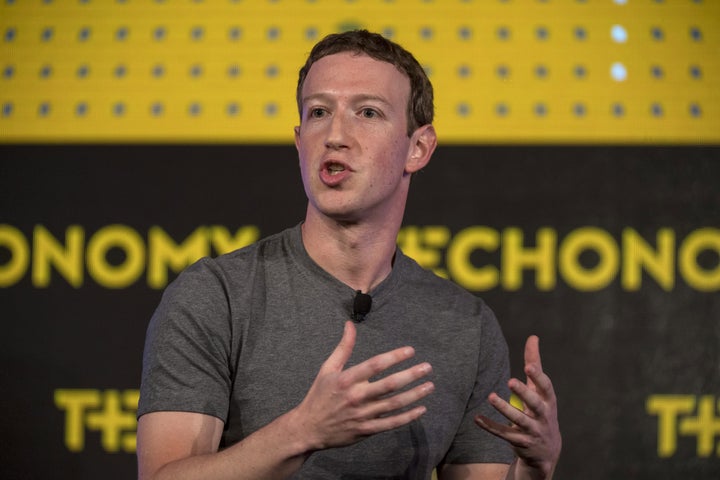
No such considerations may inhibit Mark Zuckerberg. Facebook’s CEO shows every sign of being in denial. At the Techonomy conference two days after Trump’s victory, Zuckerberg called the idea of Facebook influence on the election “crazy.” When Facebook, Google, and Twitter were called before Congress to testify about Russian meddling in the election, none of their CEOs showed up. Zuckerberg went to Beijing instead, paying homage to China’s Xi Jinping. The fifth-wealthiest person on the planet, and a tireless promoter said to harbor presidential ambitions, Zuckerberg structured even his putative philanthropy, the Chan Zuckerberg Initiative, as a for-profit LLC that’s free to invest in lobbying. Perhaps disingenuously, he framed Russian interference as a security problem, rather than as a feature of Facebook’s core business. “We’re serious about preventing abuse on our platforms. We’re investing so much in security that it will impact our profitability,” Zuckerberg said. “Protecting our community is more important than maximizing our profits.”

McNamee reports that, in 2016, he emailed a friendly warning to Zuckerberg and Facebook’s chief operating officer, Sheryl Sandberg. He documented seven instances of bad actors abusing Facebook to harm powerless people, “Jim Crow stuff,” he says now. “I hoped they’d take a look.” After waiting four months, a period that included Trump’s election, McNamee began publicly airing his concerns. “They treated it as a PR problem,” he recalls. “They never took it seriously. And now they are lobbying like crazy to protect themselves.” (Facebook has announced the belated implementation of one of McNamee’s suggestions: informing users of their contacts with Russian agents.)

Chamath Palihapitiya, formerly Facebook’s head of user growth, told an audience at Stanford University last month, “Even though we feigned this whole line of, like, ‘There probably aren’t any really bad unintended consequences,’ I think in the back, deep, deep recesses of our minds, we kind of knew something bad could happen,” he said. “We have created tools that are ripping apart the social fabric of how society works.” Facebook’s PR apparatus lashed back, “Chamath has not been at Facebook for over six years. When Chamath was at Facebook we were focused on building new social media experiences and growing Facebook around the world. Facebook was a very different company back then and as we have grown we have realised how our responsibilities have grown too. We take our role very seriously and we are working hard to improve.”

Now, if ever, is the time for CEOs, writers of algorithms and other architects of our future to take responsibility – before, crippled by self-interest, they irreparably harm us all. Artificial intelligence looms, ominous and unknowable as a Kubrick monolith. AI, like any complex digital product, is a mysterious black box guided, but not illuminated, by data and algorithms. Once set in motion, AIs make decisions that even their makers cannot fathom, much as a major airline today doesn’t know precisely how its computers priced a seat. It may not be long before AIs shape the fates of our species and our planet.

But even cadres of enlightened CEOs will not suffice to turn things around, warns Marc Rotenberg, president of the Electronic Privacy Information Center, which advocates to protect democratic institutions from digital threats. “We need to realize that the tech world cannot regulate itself,” he says. “We need to end the myth that there are technological solutions to all problems provoked by technology. We need to develop social and political solutions.”

Our ultimate champions must be ourselves. Start by quitting Facebook. Here’s how: After downloading your data, go here and click on the blue button marked “Delete My Account.” I just did it, and I feel better already. Pass it on.

Stratford Sherman, a former member of Fortune’s Board of Editors, reported on business and technology for 20 years, and co-authored Control Your Destiny or Someone Else Will.  He currently works as a leadership advisor and coach, with a clientele of Silicon Valley CEOs. He has consulted for Google and OpenAI.

Related image
Grammy-award winner Lorde has canceled a planned concert in Israel following backlash over the Israeli government’s treatment of Palestinians.
The concert was scheduled for June, but pro-Palestinian activists reached out to the 21-year-old New Zealand pop star to complain, and urged her to join a growing boycott movement against Israel.
Two activists from New Zealand, one Palestinian and one Jewish, wrote an open letter to Lorde decrying the treatment of Palestinians. They noted that it’s a particularly difficult time for Palestinians now “after the Trump administration’s decision to move” the U.S. embassy in Israel from Tel Aviv to Jerusalem in an apparent bid to shut down debate about who has rights to the city.
“A performance in Israel sends the wrong message,” writer Justine Sachs and teacher Nadia Abu-Shanab wrote in the letter. “Playing in Tel Aviv will be seen as giving support to the policies of the Israeli government, even if you make no comment on the political situation.” 
The pleas were effective with Lorde.
“Hey guys, so about this Israel show,” she said in a statement reported by The Jerusalem Post. “I’ve received an overwhelming number of messages and letters ... and I think the right decision at this time is to cancel the show. I’m not too proud to admit I didn’t make the right call on this one. I’m truly sorry to reverse my commitment to come play for you. I hope one day we can all dance.”


Concert organizer Eran Arielli apologized on Facebook to fans: “The truth is that I was naive to think that an artist of her age can withstand the pressure involved in coming to Israel.”
Israeli Culture Minister Miri Regev urged Lorde to reconsider.
“Lorde, I expect you to be a ‘pure heroine’ like the title of your first album — a pure heroine of culture, void of any foreign political considerations, not to mention delusional ones,” she said.
The New Zealand Jewish Council issued a statement saying Lorde “succumbed” to “extremist bullies.”
A boycott, divestment and sanctions campaign against Israel was founded in 2005 and a number of musicians are supporting the boycott. Singers Lauryn Hill, Elvis Costello, Gil Scott-Heron and Pink Floyd founder Roger Waters have all refused to perform in the nation. Last month, German networks announced they would no longer broadcast Waters’ concerts because of accusations of anti-semitism against him, the Guardian reported.
In an op-ed piece, The Jerusalem Post noted Lorde would have been “by far” the highest profile artist to perform in the country in 2018.


MKRdezign

{facebook#https://facebook.com} {twitter#https://twitter.com} {google-plus#https://plus.google.com} {pinterest#https://pinterest.com} {youtube#https://youtube.com} {instagram#https://instagram.com}

Contact Form

Name

Email *

Message *

Powered by Blogger.
Javascript DisablePlease Enable Javascript To See All Widget